Understanding Cat Food Labels: Ingredient Analysis Guide 2026
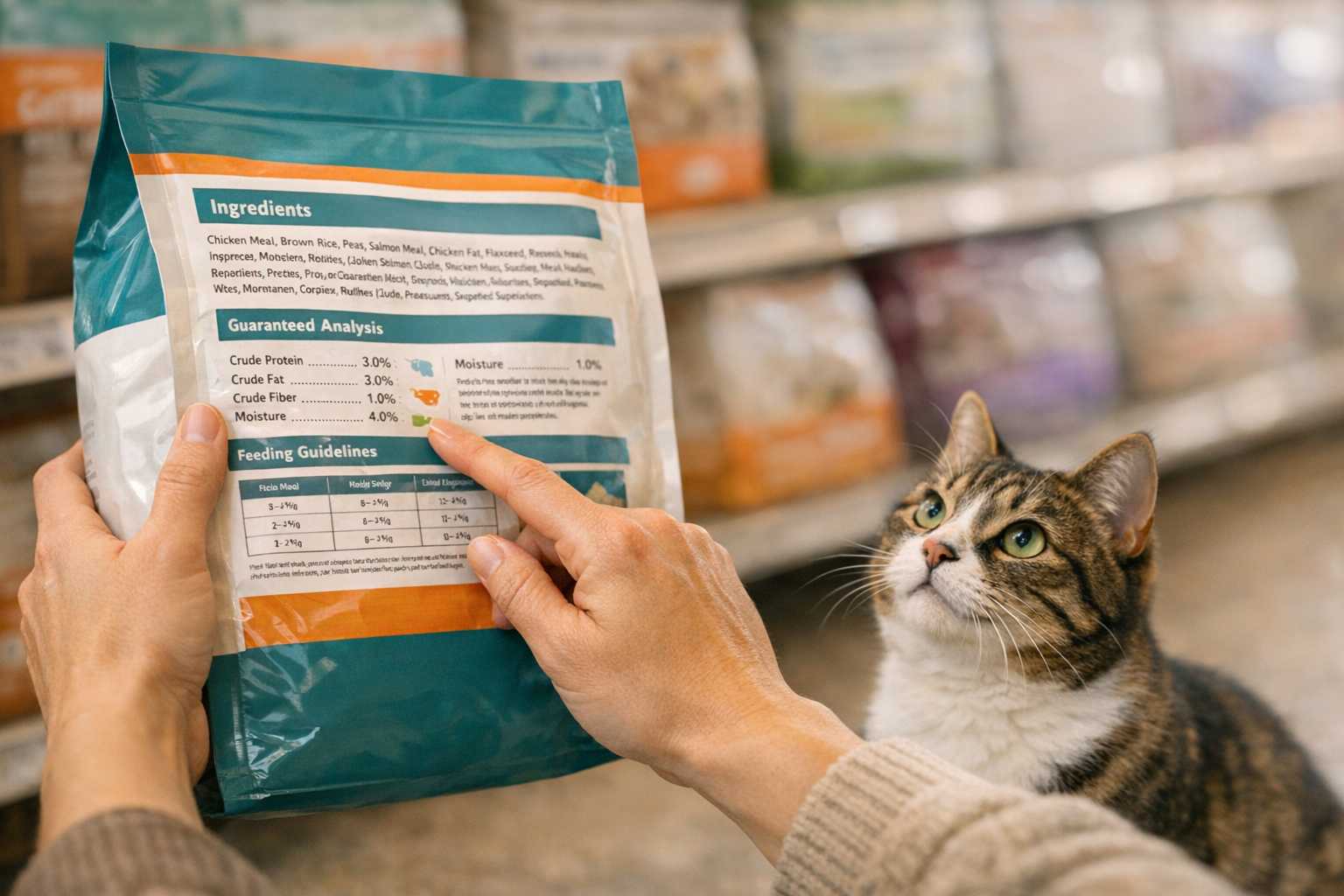
Understanding Cat Food Labels: A Practical Ingredient Analysis Guide for 2026
SEO Slug: understanding-cat-food-labels-ingredient-analysis-guide
Focus Keyphrase: cat food labels ingredient analysis
Meta Description: Learn how to read cat food labels with confidence in 2026. This practical ingredient analysis guide helps you choose healthier food for your cat.
Standing in the pet food aisle with a bag of cat food in your hands can feel oddly overwhelming. You turn the package over, start reading, and suddenly it seems like every label is written in a language only nutrition experts understand.
If that sounds familiar, you’re definitely not alone.
Many cat owners feel unsure when trying to make sense of ingredient lists, guaranteed analysis panels, and marketing claims. The reassuring part is that once you know what to focus on, cat food labels become much easier to understand.
This guide breaks it all down in a clear, practical way so you can make better choices for your cat with confidence.
Why Reading Cat Food Labels Matters
Your cat depends entirely on you to choose what goes into their bowl. That choice can influence their weight, energy levels, digestion, coat quality, hydration, and long-term health.
A good label won’t tell you everything about a food, but it can tell you a lot. Learning how to read it helps you look past flashy marketing and focus on what really matters: nutritional quality, ingredient transparency, and suitability for your cat’s life stage and health needs.
The good news is that this is a skill you can learn fairly quickly, and once you do, comparing products becomes much more straightforward.
What You’ll Find on a Cat Food Label
In the United States, pet food labels generally follow standards influenced by AAFCO (the Association of American Feed Control Officials) and applicable state and federal regulations. While exact rules vary by country, most labels include the same core information.
Here’s what you’ll usually see:
- Product name
- Net weight
- Ingredient list
- Guaranteed analysis
- Nutritional adequacy statement
- Feeding guidelines
- Manufacturer or distributor information
Each section provides a different clue about the food’s quality and purpose.
How to Interpret the Product Name
The product name is not just marketing. In many cases, it follows specific labeling rules that determine how much of a named ingredient must actually be in the food.
The 95% Rule
If a product is called “Chicken Cat Food,” the named ingredient must make up at least 95% of the product, excluding water added for processing. If you include added water, it must still make up at least 70% of the total product.
That usually indicates a very meat-heavy formula.
The 25% Rule
Terms such as “dinner,” “entrée,” “platter,” or “formula” mean the named ingredient only needs to make up at least 25% of the product, excluding water for processing, and at least 10% including water.
So “Chicken Dinner” contains much less chicken than “Chicken Cat Food.”
The 3% “With” Rule
If the label says “Cat Food with Chicken,” chicken only needs to be present at 3%.
That’s a major difference, and it’s one many shoppers miss.
The “Flavor” Rule
A label such as “Chicken Flavor” means the food must contain enough of that ingredient, or a derived flavor, to be detectable, but it does not have to contain a meaningful amount of actual chicken meat.
This is why the product name should never be your only decision-making tool.
How to Read the Ingredient List
Ingredients are listed in descending order by weight before processing. That detail matters because fresh meat contains a lot of water, which can make it appear higher on the list than it might on a dry matter basis after cooking.
Still, the ingredient list remains one of the best places to start.
What You Ideally Want to See
Cats are obligate carnivores, so it generally makes sense to look for clearly named animal protein sources, such as:
- Chicken
- Turkey
- Salmon
- Beef
- Duck
- Rabbit
A named animal protein near the top of the list is often a positive sign.
What “Meal” Means
Ingredients such as chicken meal or turkey meal often worry people unnecessarily. In reality, a named meat meal can be a useful and concentrated protein source because most of the water has already been removed.
That means it may contribute more usable protein than fresh meat by weight after processing.
Better examples include:
- Chicken meal
- Turkey meal
- Salmon meal
Less desirable examples include vague terms like:
- Meat meal
- Poultry meal
- Animal meal
Specificity matters. A named source is generally more transparent than a generic one.
Ingredients That Deserve a Closer Look
Not every questionable ingredient is automatically harmful, but some deserve more scrutiny than others.
Unnamed Animal Ingredients
Ingredients such as meat by-products, animal digest, or poultry by-products are less transparent when the animal source is not clearly identified.
That doesn’t always mean the ingredient is poor quality, but it does make it harder to evaluate. In general, named ingredients are preferable. For example, chicken liver or chicken by-products are more informative than vague animal terms.
Fillers and High-Carbohydrate Ingredients
Cats do not have a nutritional requirement for carbohydrates, although carbohydrates can still appear in complete and balanced diets. Many lower-cost foods rely heavily on ingredients such as:
- Corn
- Wheat
- Soy
- Rice
These ingredients are not inherently dangerous, but when they dominate the formula, they may reduce the overall meat content and protein quality of the diet.
The issue is less about one ingredient being “bad” and more about the overall nutritional balance of the recipe.
Artificial Preservatives and Colors
Some cat foods use synthetic preservatives or unnecessary color additives. Ingredients many owners prefer to limit or avoid include:
- BHA
- BHT
- Ethoxyquin
- Artificial colors
Natural preservatives such as mixed tocopherols are often viewed more favorably. Rosemary extract may also be used in some foods, although it is more common in dog food than cat food.
Added Sugars and Excess Salt
Cats do not need added sugar, and foods with sugar or sweeteners listed as ingredients are generally best avoided. Salt may appear in small amounts for formulation or palatability, but it should not be a standout feature of the recipe.
Understanding Guaranteed Analysis
The guaranteed analysis shows minimum or maximum levels of certain nutrients. It usually includes:
- Crude protein (minimum)
- Crude fat (minimum)
- Crude fiber (maximum)
- Moisture (maximum)
Some labels also include taurine, ash, magnesium, omega fatty acids, or other nutrients.
A few important notes:
- Crude protein refers to the estimated amount of protein, not necessarily its quality or digestibility.
- Crude fat gives you a general idea of energy density.
- Crude fiber can help you compare formulas aimed at digestion or hairball control.
- Moisture is especially important when comparing wet and dry food.
Why Dry Matter Basis Matters
Comparing wet and dry cat food directly can be misleading because wet food contains much more water. To make a fair comparison, convert nutrient values to a dry matter basis.
Use this formula:
Dry Matter % = (Nutrient % ÷ (100 - Moisture %)) × 100
For example, if a wet food contains:
- Protein: 10%
- Moisture: 78%
Then:
- 100 - 78 = 22
- 10 ÷ 22 × 100 = 45.5
So the food contains 45.5% protein on a dry matter basis.
This is why wet foods that look low in protein on the label may actually be quite protein-rich when moisture is removed from the equation.
Don’t Ignore the Nutritional Adequacy Statement
This is one of the most important parts of the label.
The nutritional adequacy statement tells you whether the food is intended to be a complete and balanced diet or whether it is only meant for occasional use.
Look for wording such as:
“[Product name] is formulated to meet the nutritional levels established by the AAFCO Cat Food Nutrient Profiles for adult maintenance.”
Or:
“Animal feeding tests using AAFCO procedures substantiate that [product name] provides complete and balanced nutrition for growth and reproduction.”
This tells you the food is meant to serve as a primary diet for a specific life stage.
Be cautious with labels that say:
“Intended for intermittent or supplemental feeding only.”
Those products are not designed to be your cat’s sole diet.
Life Stage Is Important
Make sure the food matches your cat’s stage of life:
- Growth / kitten — for growing kittens and pregnant or nursing cats
- Adult maintenance — for healthy adult cats
- All life stages — suitable for both kittens and adults, though not always ideal for every cat
- Senior — not an official AAFCO life stage, but often formulated for older cats
It’s worth noting that “senior” is largely a marketing category rather than a formally defined AAFCO nutritional life stage. Senior formulas can vary widely, so the ingredient profile matters more than the word itself.
Wet Food vs. Dry Food: What Labels Can Tell You
Many people want to know whether wet or dry food is better. The most accurate answer is that either can play a role in a healthy diet, depending on the product and the cat.
Here’s a general comparison:
| Feature | Wet Food | Dry Food | |---|---|---| | Moisture Content | Usually 70-85% | Usually 6-10% | | Protein on Dry Matter Basis | Often high | Varies widely | | Carbohydrates | Often lower | Often higher | | Storage | Refrigeration needed after opening | Easier to store | | Cost | Usually more expensive | Usually less expensive |
Wet food can support hydration, which is especially helpful for cats that naturally drink little water. Dry food is convenient and often more economical. However, dry food does not reliably clean teeth unless it is specifically designed and validated for dental care.
A mixed feeding approach works well for many households, but the best option depends on your cat’s health, preferences, and veterinary advice.
Is Grain-Free Cat Food Really Better?
Not necessarily.
Grain-free cat food can sound appealing, but grain-free does not automatically mean better, lower-carb, or more species-appropriate.
Many grain-free foods replace grains with other starch-heavy ingredients, such as:
- Potatoes
- Sweet potatoes
- Peas
- Lentils
- Tapioca
These ingredients can still contribute significant carbohydrate content. So if your goal is a lower-carbohydrate, higher-protein diet, you need to evaluate the full ingredient list and nutrient profile rather than relying on the grain-free label alone.
Also, while concerns about certain legume-heavy diets have been more widely discussed in dogs, it is still wise to choose balanced formulas from reputable manufacturers and discuss specific concerns with your veterinarian.
What “Natural,” “Organic,” and “Human-Grade” Really Mean
These claims can be useful, but they are often misunderstood.
Natural
In pet food, natural generally means ingredients derived from plant, animal, or mined sources that have not been chemically synthetic, apart from certain added vitamins, minerals, or trace nutrients.
It may suggest fewer artificial additives, but it does not automatically mean premium quality.
Organic
If a product is truly USDA organic certified, that claim has more weight. It refers to how ingredients were produced and handled, with restrictions on synthetic pesticides and other agricultural practices.
Organic may matter to some owners, but it does not necessarily mean the food is nutritionally superior for every cat.
Human-Grade
Human-grade is a meaningful claim only when every ingredient and the final product meet human food standards and are manufactured, packed, and stored in accordance with regulations for human edible foods.
When used correctly, it can indicate a high production standard. But as always, the full nutritional profile still matters.
How to Compare Two Cat Foods More Effectively
When choosing between products, use a simple checklist:
✅ Is there a clearly named animal protein near the top of the ingredient list?
✅ Are the first several ingredients reasonably consistent with a carnivorous diet?
✅ Does the food include an AAFCO nutritional adequacy statement?
✅ Is it appropriate for your cat’s life stage and health needs?
✅ Are ingredient sources specific rather than vague?
✅ Are preservatives acceptable to you?
✅ Can you compare the food on a dry matter basis if needed?
✅ Is the manufacturer transparent and reputable?
No single food has to be perfect, but this checklist can help you make a more informed comparison.
Common Questions About Cat Food Labels
Is the first ingredient always the most important?
Not always. Since ingredients are listed by pre-cooking weight, fresh meat may appear first because of its water content. A named meat meal lower on the list may still contribute substantial protein after processing.
Are by-products always bad?
No. Organ meats and some by-products can be highly nutritious. The main issue is transparency. Named by-products are easier to evaluate than vague, unnamed ones.
Does expensive food always mean better food?
No. Price can reflect branding, packaging, or niche marketing just as much as ingredient quality. The label matters more than the price tag alone.
How can I tell whether a brand is trustworthy?
Look for clear ingredient sourcing, transparent contact information, recall history, quality control practices, and willingness to answer customer questions. Your veterinarian can also help you assess whether a food is appropriate for your cat.
Cat Food Label Trends in 2026
Cat food packaging continues to evolve, and a few trends are becoming more common:
- Fresh and freeze-dried formulas are increasingly available
- Alternative proteins, including insect protein, are gaining attention
- Brand transparency is becoming a stronger consumer expectation
- QR codes often link to sourcing, manufacturing, and testing information
- Personalized nutrition based on age, lifestyle, and health status is expanding
These trends can be helpful, but they should still be evaluated with the same critical eye you would use for any label.
Final Thoughts
Reading cat food labels can seem intimidating at first, but it becomes much easier once you understand the structure behind the wording. The goal is not to memorize every regulation or obsess over every ingredient. It’s simply to become informed enough to separate meaningful information from clever marketing.
Your cat relies on you to make those decisions, and even a few extra minutes spent reading a label can make a real difference over time.
The next time you shop, turn the package over and take a closer look. Focus on the ingredient quality, the nutritional adequacy statement, the life stage, and the overall balance of the recipe. That small habit can help you choose food more confidently and support your cat’s health for years to come.
If you have questions about a specific ingredient or want help comparing two cat foods, feel free to ask in the comments.
Last Updated: 2026 | Always consult your veterinarian for personalized dietary advice for your cat.